Right ovarian torsion during pregnancy: a case report
Duncan Mwangangi Matheka
Corresponding author: Duncan Mwangangi Matheka, Department of Obstetrics and Gynecology, Machakos Level 5 Hospital, Machakos, Kenya 
Received: 06 Mar 2025 - Accepted: 21 Aug 2025 - Published: 04 Nov 2025
Domain: Gynecology,Obstetrics and gynecology
Keywords: Ovarian cyst, serous cystadenomas, salpingo-oophorectomy, necrotic or gangrenous ovary, case report
Funding: This work received no specific grant from any funding agency in the public, commercial, or not-for-profit sectors.
©Duncan Mwangangi Matheka et al. PAMJ Clinical Medicine (ISSN: 2707-2797). This is an Open Access article distributed under the terms of the Creative Commons Attribution International 4.0 License (https://creativecommons.org/licenses/by/4.0/), which permits unrestricted use, distribution, and reproduction in any medium, provided the original work is properly cited.
Cite this article: Duncan Mwangangi Matheka et al. Right ovarian torsion during pregnancy: a case report. PAMJ Clinical Medicine. 2025;19:14. [doi: 10.11604/pamj-cm.2025.19.14.47152]
Available online at: https://www.clinical-medicine.panafrican-med-journal.com//content/article/19/14/full
Case report 

Right ovarian torsion during pregnancy: a case report
Right ovarian torsion during pregnancy: a case report
Duncan Mwangangi Matheka1,&
&Corresponding author
Ovarian torsion (OT) is a gynecological emergency presenting as acute abdominal pain. The incidence is approximately 5 per 10,000 pregnancies, with pregnancy increasing the risk five-fold. Ultrasound, the preferred imaging modality, has low negative predictive value, making diagnosis challenging. Early intervention with ovarian conservation surgery, such as cystectomy, is recommended. In delayed cases, oophorectomy may be required for gangrenous ovaries. We report a case of ovarian torsion in pregnancy requiring oophorectomy due to late hospital presentation. A 26-year-old primigravida at 24 weeks´ gestation presented with a one-week history of worsening right iliac fossa pain. Abdominal ultrasound revealed a 10 cm ovarian cyst with absent Doppler flow. A diagnosis of ovarian torsion was made, and emergency laparotomy revealed a twisted, necrotic right ovarian cyst. A right salpingo-oophorectomy was performed. Histopathology confirmed a necrotic benign serous cystadenoma. Her pregnancy remained uneventful, and she delivered a healthy male infant vaginally at term. In conclusion, ovarian torsion diagnosis is challenging and requires a high index of suspicion. Early intervention improves maternal and fetal outcomes. Although antenatal surgery is generally safe, surgical risks necessitate careful management decisions based on gestational age and cyst characteristics.

Ovarian torsion is the twisting of the ovary, fallopian tube, or both around the vascular pedicle, leading to venous obstruction, stromal edema, infarction, and necrosis. The cyst may become tense and rupture [1,2]. It commonly affects the right ovary due to the left ovary´s limited mobility from the sigmoid colon [2]; and is most commonly seen in dermoid and serous cystadenomas [3]. Risk factors include increased ovarian size, mobility, long pedicle, and assisted reproductive technologies [3,4]. Torsion of ovarian masses occurs predominantly among women in the reproductive age [5]. The majority of the cases present in pregnant women (22.7%) versus non-pregnant women (6.1%). The risk of ovarian torsion increases five-fold during pregnancy, to an incidence of 5 per 10,000 pregnancies [6]. Patients present with acute abdominal pain, and abdomino-pelvic examination may reveal a tender cystic mass separate from the uterus [3]. The diagnosis relies on clinical presentation and imaging. Color Doppler ultrasound may show decreased or absent blood flow, but its reliability is limited. Early diagnosis is essential to preserve ovarian function and prevent severe complications [5]. We report a case of ovarian torsion in pregnancy managed at Machakos Level 5 Hospital.

Patient information: LKN, a 26-year-old primigravida who presented to the emergency unit of Machakos Level 5 Hospital at 24 weeks´ gestation with one-week of worsening right iliac fossa pain, sharp and non-radiating. She had no associated vaginal bleeding, gastrointestinal, or urinary symptoms. Her previous menstrual cycle was regular and conception was spontaneous, with no previous treatment for infertility. She had regular antenatal visits, and her pregnancy had been uneventful.
Clinical findings: on examination, she was hemodynamically stable with a pulse rate of 92 beats per minute, blood pressure of 130/80 mm of mercury, temperature of 36.9°C and SPO2 of 98%. Abdominal examination revealed a fundal height of 24 weeks, a regular fetal heart rate, a tender right adnexal mass, and uterine irritability without peritoneal signs. Cardiovascular, central nervous and respiratory systems were normal.
Timeline of current episode: when she was 24 weeks´ gestation, she presented with one-week of worsening right iliac fossa pain, sharp and non-radiating, and not relieved by analgesics.
Diagnostic assessment: laboratory investigations, including inflammatory markers and renal and liver function tests, were normal. Abdomino-pelvic ultrasonography revealed a 10cm by 10 cm anechoic ovarian cyst in the right iliac fossa with a thin septation and absent Doppler flow. Obstetric ultrasound showed a single intrauterine live fetus in longitudinal lie with cephalic presentation at 24 weeks´ gestational age. The estimated fetal weight was 632 grams, amniotic fluid was adequate, placental position was at the posterior upper segment, and no abruption was reported.
Diagnosis: the examination findings were consistent with ovarian torsion in pregnancy.
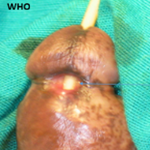
Therapeutic interventions: she received tocolytics, progesterone, and analgesics before emergency laparotomy. Under spinal anesthesia, abdomen was opened via sub-umbilical midline incision. Surgical findings included a 10 cm necrotic right ovarian cyst twisted three times around its pedicle (Figure 1). After detorsion, the ovary remained non-viable, necessitating right salpingo-oophorectomy.
Follow-up and outcome of interventions: patient had an uneventful recovery and was discharged on the fourth post-operative day. Histopathology confirmed a necrotic benign serous cystadenoma. Her pregnancy proceeded without complications, and she delivered a healthy male infant vaginally at term.
Patient perspective: our patient was satisfied with the care and treatment received at Machakos level 5 hospital.
Informed consent: informed consent was obtained from the patient, and her identity was concealed.
Ovarian torsion is a rare but serious pregnancy complication [3,7]. Delayed diagnosis can lead to ovarian loss due to prolonged ischemia [4]. The risk increases in pregnancy due to ovarian enlargement from corpus luteum cysts or benign tumors, such as serous cystadenomas. Most torsions occur in the first trimester, though they can also present later [8]. Diagnosis is often challenging in resource-limited settings. While ultrasound is the first-line imaging modality, it has limitations, particularly in detecting early-stage torsion. MRI can be more sensitive but is not always accessible [3,7]. Surgical management remains the definitive treatment. Laparoscopy is preferred in early pregnancy but is technically challenging in later gestation [9]. Laparotomy is more common in advanced pregnancy, as in this case. Conservative approaches, such as cystectomy and detorsion, are preferred for ovarian preservation [10]. However, necrotic ovaries necessitate oophorectomy [3]. Histopathological evaluation is crucial, although most ovarian masses in pregnancy are benign [3]. Despite surgical intervention, maternal and fetal outcomes remain favorable when managed appropriately. This case highlights the importance of early recognition and intervention to optimize outcomes in resource-constrained settings.
Ovarian torsion in pregnancy is rare but requires prompt diagnosis and intervention. Delayed presentation increases the likelihood of oophorectomy. High clinical suspicion, timely imaging, and early surgical management improve prognosis. In resource-limited settings, challenges in diagnostic imaging necessitate reliance on clinical acumen and surgical decision-making. There is need to have more access and training in laparascopy in low resource-constrained settings.
The author declares no competing interests.
Patient management, Manuscript drafting: Duncan Mwangangi Matheka. The author has read and agreed to the final version of this manuscript.
Figure 1: image of torsional necrotic ovarian cyst in pregnancy
- Ssi-Yan-Kai G, Rivain A-L, Trichot C, Morcelet M-C, Prevot S, Deffieux X et al. What every radiologist should know about adnexal torsion. Emerg Radiol. 2018;25(1):51-9. PubMed | Google Scholar
- Nanni M, Merola MG, Ianniello S, Orazi C, Schingo PM, Trinci M. Ovarian Torsion BT - Imaging Non-traumatic Abdominal Emergencies in Pediatric Patients. In: Miele V, Trinci M, editors. Cham: Springer International Publishing; 2016;205-27. PubMed | Google Scholar
- Kolluru V, Gurumurthy R, Vellanki V, Gururaj D. Torsion of ovarian cyst during pregnancy: A case report. Cases J. 2009 Dec 31;2:9405. PubMed | Google Scholar
- Kumari S. A rare case of ovarian torsion in a pregnant patient. International Journal of Reproduction, Contraception, Obstetrics and Gynecology. 2022 Jan 1;11(1):255-9. Google Scholar
- Gaidhani KA, Harwalkar M, Nirgude PS. World journal of pharmaceutical research seed extracts. World J Pharm Res. 2014;3(3):5041-8. Google Scholar
- Rizk B, Borahay MA, Ramzy AM, editors. Clinical Diagnosis and Management of Gynecologic Emergencies. CRC Press; 2020. Google Scholar
- Dahiya LP. Ovarian mass in pregnancy: a case report. International Journal of Reproduction, Contraception, Obstetrics and Gynecology. 2015 Jun 1;4(3):915-8. Google Scholar
- Hasiakos D, Papakonstantinou K, Kontoravdis A, Gogas L, Aravantinos L, Vitoratos N. Adnexal torsion during pregnancy: Report of four cases and review of the literature. J Obstet Gynaecol Res. 2008 Aug;34(4 Pt 2):683-7. PubMed | Google Scholar
- Oelsner G, Cohen SB, Soriano D, Admon D, Mashiach S, Carp H. Minimal surgery for the twisted ischaemic adnexa can preserve ovarian function. Hum Reprod. 2003 Dec;18(12):2599-602. PubMed | Google Scholar
- Wang Z, Zhang D, Zhang H, Guo X, Zheng J, Xie H. Characteristics of the patients with adnexal torsion and outcomes of different surgical procedures A retrospective study. Medicine (Baltimore). 2019 Feb;98(5):e14321. PubMed | Google Scholar
Search

This article authors
On Pubmed
On Google Scholar
Citation [Download]
Navigate this article
Similar articles in
Key words
Tables and figures

Article metrics
PlumX Metrics
Right ovarian torsion during pregnancy: a case reportRecently from the PAMJ-CM