Early preterm abdominal pregnancy in HIV-positive multigravida woman: a case report
Reuben Nyongesa Kere, Caren Omoro Otadoh, Stephen Otieno Gwer
Corresponding author: Reuben Nyongesa Kere, Department of Obstetrics and Gynaecology, Maseno University, Kisumu, Kenya 
Received: 29 Sep 2025 - Accepted: 11 Nov 2025 - Published: 17 Nov 2025
Domain: Obstetrics and gynecology
Keywords: Abdominal pregnancy, ectopic pregnancy, HIV infections, secondary abdominal pregnancy, case report
Funding: This work received no specific grant from any funding agency in the public, commercial, or not-for-profit sectors.
©Reuben Nyongesa Kere et al. PAMJ Clinical Medicine (ISSN: 2707-2797). This is an Open Access article distributed under the terms of the Creative Commons Attribution International 4.0 License (https://creativecommons.org/licenses/by/4.0/), which permits unrestricted use, distribution, and reproduction in any medium, provided the original work is properly cited.
Cite this article: Reuben Nyongesa Kere et al. Early preterm abdominal pregnancy in HIV-positive multigravida woman: a case report. PAMJ Clinical Medicine. 2025;19:16. [doi: 10.11604/pamj-cm.2025.19.16.49560]
Available online at: https://www.clinical-medicine.panafrican-med-journal.com//content/article/19/16/full
Case report 

Early preterm abdominal pregnancy in HIV-positive multigravida woman: a case report
Early preterm abdominal pregnancy in HIV-positive multigravida woman: a case report
 Reuben Nyongesa Kere1,&, Caren Omoro Otadoh1, Stephen Otieno Gwer1
&Corresponding author
Abdominal ectopic pregnancy (AEP) is a rare, life-threatening form of ectopic gestation, accounting for less than 1.4% of ectopic pregnancies, with a maternal mortality rate up to 20%. Limited literature suggests a link between HIV infection and increased risk. We report a 38-year-old, HIV-positive woman (G5 P3+1) on HAART with an unknown last normal menstrual period, presenting with abdominal pain and severe anaemia. Ultrasound confirmed a single, live abdominal pregnancy at 30 weeks and 4 days of gestation with a non-gravid uterus, diagnosed as early preterm secondary AEP. We performed an elective laparotomy, resulting in the delivery of a live male infant (990g) and complete placental removal via left adnexectomy. The mother had a favourable outcome. The infant died at eight months due to failure to thrive, emphasizing the necessity for sustained postnatal support to overcome adverse outcomes related to social determinants of health, even after successful surgical intervention.

Abdominal ectopic pregnancy (AEP) accounts for less than 1.4% of all ectopic pregnancies [1,2]. It is defined as a pregnancy in the peritoneal cavity, external to the uterine and tubal lumens. Abdominal ectopic pregnancy (AEP) is classified as either primary (ovum implants directly on the peritoneum) or secondary (ovum is expelled from the fallopian tube and subsequently implants on a viscus or mesentery) [3]. Secondary AEP is the most common. Abdominal ectopic pregnancy (AEP) carries a maternal mortality rate of up to 20%, a rate seven to eight times higher than other forms of ectopic pregnancy [1,4]. Fetal survival is also poor, with a neonatal mortality rate estimated to be between 40% and 80% due to prematurity, growth restriction, and fetal malformations [5]. Risk factors are similar to those for tubal ectopic pregnancies, including a history of pelvic inflammatory disease (PID), previous ectopic pregnancy, and assisted reproductive technologies. Limited literature suggests a potential association between HIV infection and an increased risk of ectopic pregnancy [6,7]. This report details the management of a rare case of advanced AEP in an HIV-positive woman, emphasizing the diagnostic and surgical challenges.

Patient information: B.A. is a 38-year-old, G5 P3+1 woman with three living children. Her last delivery was a normal vaginal birth in 2013. Her last normal menstrual period (LNMP) was unknown, but she was certain it was not in the preceding three months, suggesting an advanced pregnancy. She presented to the teaching hospital labour ward as a referral with abdominal pains of one month's duration. The pains were spontaneous in onset, localized predominantly above the umbilicus, and occasionally radiated to her back. She perceived fetal movements and reported no vaginal bleeding. Notably, she had a history of using combined oral contraceptive pills for three years before the current pregnancy. Her antenatal profile revealed severe anaemia (Hb 5.6 g/dL) and HIV-positive status. She had been living with HIV for 8 years and was compliant with highly active antiretroviral therapy (HAART), with an undetectable viral load two years prior.
Clinical findings: on general examination, she was moderately pale and in mild pain. Her vital signs were stable. Abdominal examination showed a distended abdomen with visible fetal movements. A palpable mass of 30 cm in diameter in the right upper quadrant suggested a transverse lie. Fetal heart rate was 154 bpm. The findings were non-specific, necessitating immediate and detailed imaging.
Ultrasound and laboratory assessment: ultrasound at admission revealed a non-gravid uterus and confirmed a single, live abdominal pregnancy at 30 weeks and 4 days of gestation with adequate amniotic fluid and a fetal heart rate of 157 bpm. The estimated fetal weight was 1,540g. Laboratory investigations confirmed severe anaemia (Hb 6.0 g/dL) (Table 1).
Timeline and diagnostic assessment: the patient was admitted with abdominal pregnancy and severe anaemia. Over the next 12 days, she received blood transfusions, intramuscular dexamethasone for fetal lung maturity, and haematinics. A repeat ultrasound suggested placental implantation on the left adnexa.
Final diagnosis: early preterm secondary abdominal ectopic pregnancy in an HIV-Positive Multigravida Woman. We categorized it as secondary AEP because we found the placenta implanted on the left fallopian tube, mesosalpinx, left ovary, and adjacent broad ligament during surgery. The empty uterus and a viable fetus seen on ultrasound were critical for the diagnosis.
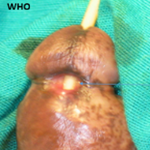
Therapeutic intervention and outcome: on day 13 of admission, after stabilization and fetal lung maturation, the obstetric team performed an elective laparotomy, with a general surgeon on standby. The surgical team balanced the need for early delivery to mitigate maternal risk against complications from continuing the pregnancy, deciding to proceed once the fetus achieved better maturity. Under general anaesthesia, we made a midline abdominal incision 5cm above and below the umbilicus. This exposed an intra-abdominal gestational sac in the free peritoneal cavity, lacking any uterine-like muscle layer (Figure 1). We made a transverse incision on the membranes and suctioned clear amniotic fluid before delivery (Figure 2). We extracted a live male infant in breech presentation. The birth weight was 990 grams, with APGAR scores of eight at one and nine at 5 minutes, respectively. The placenta was firmly implanted on the left adnexa (Figure 3). We performed a left adnexectomy by ligating the vascular stalk with polyglactin sutures to achieve complete hemostasis, as complete placental removal is the ideal management strategy in AEPs with limited visceral attachment. Estimated blood loss during the procedure was minimal (approximately 300 ml). The patient recovered well, and we discharged her on day 10 post-operation.
Follow-up and prognosis: maternal outcome: we discharged the mother with a stable haemoglobin level and a good prognosis. Neonatal Outcome: We admitted the baby to the neonatal unit for prematurity (Figure 4) and initiated prophylactic HAART. The HIV PCR test at six weeks was negative, confirming no transmission. We discharged the infant on day 87, weighing 2,475 grams, but retained in the hospital on compassionate grounds to benefit from free formula milk due to the mother's difficulty with lactation. Despite initial survival, the infant died at eight months of age due to failure to thrive, a complication made worse by severe feeding difficulties and the socioeconomic challenges of the family.
Patient perspective: "I didn't know my pregnancy was abnormal, and the diagnosis of an abdominal pregnancy was terrifying, but I was very thankful for the care that saved my baby. Even though I was heartbroken when my son died eight months later, I am still grateful for the medical team that helped us."
Informed consent: we obtained a written informed consent from the patient for the publication of this case report.
This case represents a rare occurrence of advanced AEP (>20 weeks of gestation) with a viable fetus [5]. While we did not identify a clear single cause, the patient's history of oral contraceptive use and HIV-positive status (though with an undetectable viral load) are potential confounding factors. The decision to allow the pregnancy to continue to 30 weeks was a calculated risk, aimed at improving fetal viability, given the patient's stable condition. Studies have highlighted successful outcomes even in term abdominal pregnancies, provided the patient is stable [8,9]. The association between HIV infection and AEP is an area with limited literature. However, some evidence suggests a link between HIV and ectopic pregnancy in general, particularly in high-prevalence settings. A case report from Tanzania detailed a secondary abdominal pregnancy in an HIV-positive woman, emphasizing the complexity of managing this rare condition in the setting of chronic infection [6]. Furthermore, a retrospective study conducted in South Africa reported a significantly higher prevalence of HIV-1 infection in the ectopic pregnancy cohort compared to normal intrauterine pregnancies [7]. This suggests that HIV status may be a general risk factor for abnormal implantation, potentially due to altered tubal function, increased pelvic inflammatory disease (PID) susceptibility, or immune-mediated changes. Our patient's stable HIV status on HAART with an undetectable viral load does not negate the historical risk factors this infection may impart.
Studies affirm the critical role of ultrasonography in diagnosis, as it reveals the empty uterus and a viable fetus with an extra-uterine gestational sac [3,10]. This is especially crucial in resource-limited settings where higher-resolution imaging, such as MRI (recommended for better delineation of placental attachment), may not be accessible. This case highlights the uncertainty of preoperative imaging because obstetricians revised the placental attachment site from the mesentery to the left adnexa during surgery. The decision to perform a complete placental removal via left adnexectomy was vital for the mother´s favourable outcome [4,8]. Complete removal, where feasible due to limited visceral attachment, is the preferred approach as it minimizes risks such as life-threatening infection, secondary haemorrhage, and placental abscess formation associated with leaving the placenta in situ [4]. The surgical team's ability to ligate the vascular pedicle of the adnexa successfully was key to achieving complete hemostasis. The infant's survival to eight months, despite being delivered extremely preterm, is significant, given the estimated neonatal mortality rate of up to 80% for AEPs [5]. Studies on advanced AEP show that few fetuses survive beyond the immediate neonatal period, with the longest reported neonatal survival being only 14 days in some low-resource contexts [8]. The unfortunate late neonatal death from failure to thrive at eight months of age underscores the profound impact of social determinants of health, even after successful clinical intervention [9]. This emphasizes the need for comprehensive postnatal support, particularly regarding nutrition and socioeconomic stability, for patients facing complex obstetric conditions like AEP, especially those living with HIV, as has been highlighted in other South African contexts [9].
Advanced AEP with a viable fetus is a rare but high-risk obstetric emergency. Literature links HIV infection to AEP. Timely diagnosis via ultrasound, multidisciplinary surgical management involving complete placental removal where feasible and subsequent intensive neonatal care are crucial for optimizing maternal and fetal outcomes. This case illustrates the successful clinical management of the emergency, but also highlights the necessity of sustained postnatal support to prevent adverse outcomes related to social determinants of health.
The authors declare no competing interests.
All the authors have read and agreed to the final manuscript.
The authors thank the patient for consenting to this publication.
Table 1: laboratory results
Figure 1: abdominal incision revealing a gestational sac in the free peritoneal cavity
Figure 2: amniotomy with drainage of amniotic fluid
Figure 3: placenta and membranes confined to the left adnexa
Figure 4: mother and baby in the neonatal unit
- Tegene D, Nesha S, Gizaw B, Befikadu T. Laparotomy for advanced abdominal ectopic pregnancy. Case Reports in Obstetrics and Gynecology. 2022;2022(1):3177810. PubMed | Google Scholar
- Harries S, Tooke L, Imbeault JC, Matjila M, Pillay S. Advanced abdominal pregnancy at a tertiary hospital in South Africa: a case series. AJOG Global Reports. 2025 May 1;5(2):100500. PubMed | Google Scholar
- Hajji A, Toumi D, Laakom O, Cherif O, Faleh R. Early primary abdominal pregnancy: diagnosis and management. A case report. International Journal of Surgery Case Reports. 2020 Jan 1;73:303-6. PubMed | Google Scholar
- Chen Y, Peng P, Li C, Teng L, Liu X, Liu J, Cao D, Zhu L, Lang J. Abdominal pregnancy: a case report and review of 17 cases. Archives of Gynecology and Obstetrics. 2023 Jan;307(1):263-74. PubMed | Google Scholar
- El Farouqi A, Iraki E, Boumezzough A. Management of a Second-Trimester Abdominal Pregnancy: A Case Report and Review of the Literature. Open Journal of Obstetrics and Gynecology. 2022 Jan 12;12(1):33-42. Google Scholar
- Kim MC, Manyanga H, Lwakatare F. Secondary abdominal pregnancy in human immunodeficiency virus-positive woman. Obstetrics & Gynecology Science. 2016 Nov 15;59(6):535. PubMed | Google Scholar
- Mohosho MM. The association between the prevalence of HIV infection and ectopic pregnancy. African Journal of Reproductive Health. 2023 Apr 4;27(2):87-91. PubMed | Google Scholar
- Magezi J, Wacha J, Pebalo PF. Chronicles of an uncommon term abdominal pregnancy with successful outcome: a case report. Journal of Medical Case Reports. 2024 Jan 24;18(1):61. PubMed | Google Scholar
- Tshiambara P, Hoffman M, Legodi H, Balakrishna Y, Feucht U. Dietary intake and growth of HIV exposed and unexposed 6-12 months old infants in South Africa. Maternal & Child Nutrition. 2025 Jan;21(1):e13740. PubMed | Google Scholar
- Ranaei-Zamani N, Palamarchuk T, Kapoor S, Kaler MK, Atueyi F, Allen R. Diagnostic challenges of an abdominal pregnancy in the second trimester. Case Reports in Obstetrics and Gynecology. 2021;2021(1):7887213. PubMed | Google Scholar
Search

This article authors
On Pubmed
On Google Scholar
Citation [Download]
Navigate this article
Similar articles in
Key words
Tables and figures



Article metrics
Recently from the PAMJ-CM