
eISSN: 2707-2797

Graves' acropachy in an euthyroid patient

Gabriel Canhete Machado, Letícia Schwerz Weinert

PAMJ-CM. 2025; 18:4. Published 17 Jun 2025 | DOI: 10.11604/pamj-cm.2025.18.4.45649
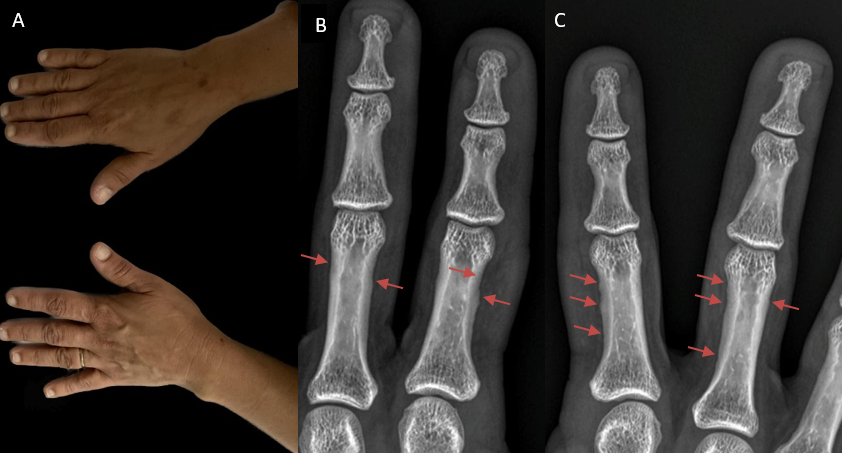
Graves' acropachy in an euthyroid patient
A 49-year-old Brazilian woman with a six-year diagnosis of Graves' disease (GD) for positive thyrotropin receptor antibody (TRAb) and a 37-pack-year smoking history was hospitalized for cardiovascular investigation after palpitations. During evaluation, she reported at least five years of untreated GD, describing swelling hands and intermittent pain in her finger joints for eight months. Physical exam revealed thickened skin, decreased sensitivity, and slight swelling of fingers, particularly in the upper extremity digits (A). No clubbing, erythema, or pain were noted. Radiographs showed finger swelling and fluffy asymmetric periosteal bone reaction on the second and third metacarpals of both hands (B and C, arrows), consistent with Graves' acropachy. This rare, extreme manifestation of GD has no specific treatment and typically occurs in moderate to severe cases. Unusually, the patient was euthyroid and had a negative TRAb, despite the lack of recent endocrine management. Graves' acropachy affects 8 in every 1,000 GD patients and is frequently linked to smoking. Differential diagnoses include myxedema and traumatic injury. Clinical and radiological evaluation, particularly swelling hands with x-rays showing new bone formation in the metacarpals, confirms the diagnosis. Although no cure exists, controlling GD may slow osteo-deposition progression.

Corresponding Author

Gabriel Canhete Machado, Department of Internal Medicine, University Hospital Of Pelotas, Federal University Of Pelotas, Pelotas, Brazil (gabrielcanhete@hotmail.com)

Article Formats

Articles published in PAMJ Clinical Medicine are Open Access and distributed under the terms of the Creative Commons Attribution 4.0 International (CC BY 4.0).

Open Access Logo

The PAMJ Clinical Medicine (ISSN: 2707-2797) is a product of the PAMJ. The contents of this journal is intended exclusively for professionals in the medical, paramedical and public health and other health sectors.