
eISSN: 2707-2797

Horseshoe kidneys

Asaad El Bakkari, Najwa Ech-Chrif El Kettani

PAMJ-CM. 2020; 3:22. Published 19 May 2020 | DOI: 10.11604/pamj-cm.2020.3.22.22996
Horseshoe kidneys
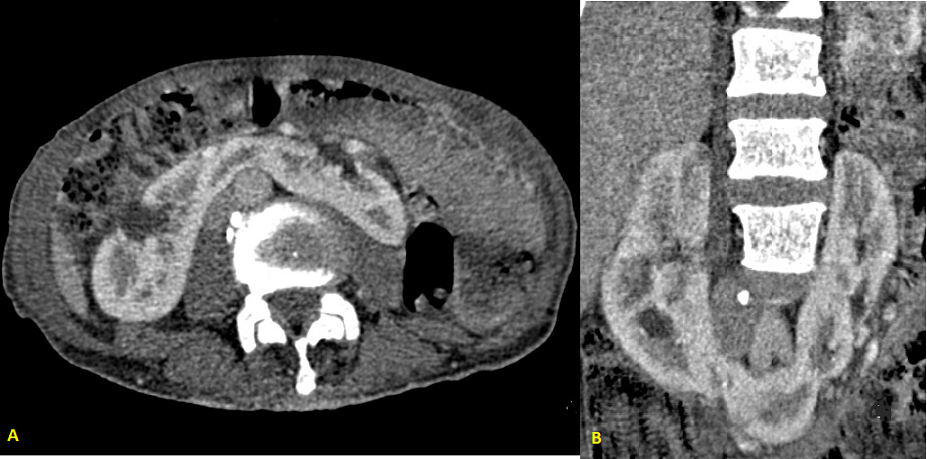
Our case is about a 38 year old male who consult in emergency for a car accident with severe head trauma. In front of that we realized a body CT, the abdominal images finds a renal tissue of normal imaging appearance, but with both renal lower poles pointing medially and fused across the midline by an isthmus of functioning renal tissue characteristic of Horseshoe kidneys (HSK) (A) , the ureters arise from the kidneys anterior rather than medially. HSK is one of the most common renal fusion anomalies with a prevalence of 0.25% among the general population. He can be isolated in 30% of cases, but most frequently he is associated with panoply of genitourinary and non-genitourinary malformations, and he is also seen as part of a number of syndromes anomalies. The most commonly associated are ureteropelvic junction obstruction, lithiasis and renal infections with a higher risk of renal traumatic lesion and increased incidence of certain renal malignancies. Clinically HSK are mostly asymptomatic, they are however prone to a number of complications as a result of poor drainage, which may lead to clinical presentation. The diagnosis essentially is made by the CT he contribute also o the evaluation of urinary tract anatomy and pathologies associated.

Corresponding Author

Asaad El Bakkari, Neuroradiology Department Head and Neck Hospital of Rabat, Rabat, Morocco (elbakkari.asaad@gmail.com)

Article Formats

Articles published in PAMJ Clinical Medicine are Open Access and distributed under the terms of the Creative Commons Attribution 4.0 International (CC BY 4.0).

Open Access Logo

The PAMJ Clinical Medicine (ISSN: 2707-2797) is a product of the PAMJ. The contents of this journal is intended exclusively for professionals in the medical, paramedical and public health and other health sectors.