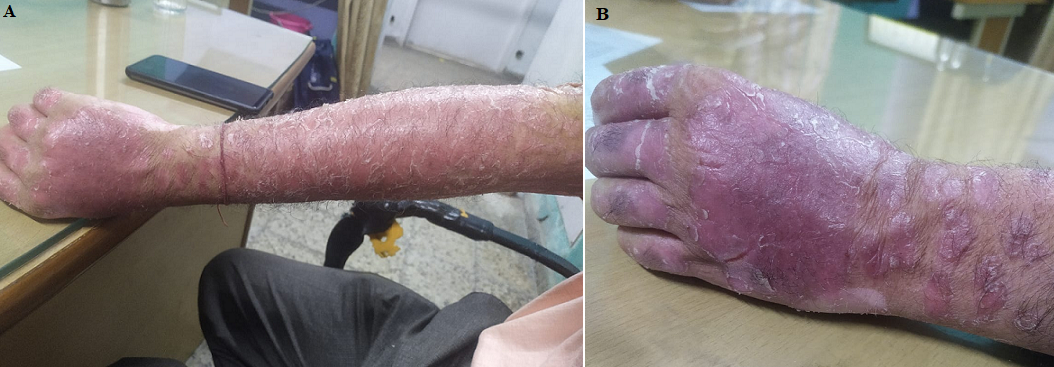
A 52-year-old male patient came in outpatient department (OPD) with complaints of erythematous plaques, scaling, redness and itching over skin of upper limbs since 4 years and having history of high bilirubin level with known case of diabetes and hypertension. Psoriasis is a chronic inflammatory noncommunicable, painful, hyper proliferative, disfiguring, disabling skin disease with great negative impact on patient's quality of life. It is characterized by well-defined, erythematous scaly plaques, particularly affecting extensor surfaces and scalp, and usually follows a relapsing, remitting course, and is associated with a number of co morbidities in both sexes and at any age. The pathogenesis of psoriasis is multifactorial and genetic and environmental factors with sustained inflammation that leads to uncontrolled keratinocyte proliferation and dysfunctional differentiation. In case psoriasis vulgaris the lesion is a raised, well-demarcated erythematous plaque of variable size. Symptoms are silver/white scaling of the skin, itching, erythema, fatigue, swelling, burning, and bleeding. The most common sites are the extensor surfaces, elbows, knees and lower back. Treatment is based on psoriasis severity at the time of presentation. Treatment categories in psoriasis are- <i>Topical agents</i> like emollients, tars, dithranol, vitamin D agonists, corticosteroids. <i>Photo(chemo)therapies</i> like UVB, PUVA. <i>Systemic agents</i> like retinoids, immunosuppressants, immunomodulators, biological immunosuppressants.
Corresponding Author
Shivam Sharma, Department of Shalyatantra, Datta Meghe Institute of Medical Sciences, Wardha, Maharashtra, India (shivamsharma1896@gmail.com)