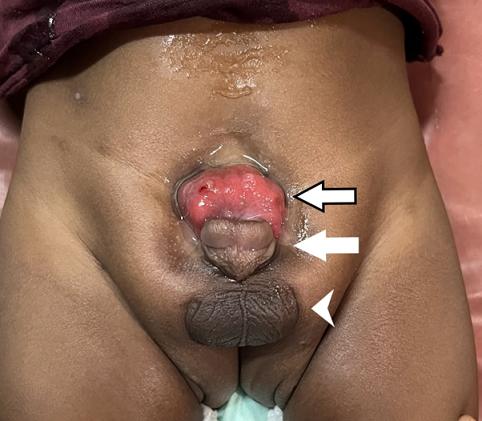
A 2-year-old male, with the bladder exstrophy-epispadias complex since birth presents to the department of surgical pediatrics for surgical management. Exposed, everted bladder template is clearly obvious immediately below umbilicus; left and right corpora cavernosa are visible beneath and alongside urethral plate; the scrotum is caudally displaced. A spectrum of congenital defects epispadias, typical bladder exstrophy, and cloacal exstrophy, make up the exstrophy-epispadias complex (EEC). Nelson <i>et al</i>. 5 calculated the total incidence of EEC at 2.15 per 100,000 live births, with an equal male-to-female ratio. Normal invagination of the urogenital system begins at the end of the third week of pregnancy in the intermediate layer of mesoderm, while the lateral plate mesoderm contributes to the formation of the primitive gut tube. EEC develops because of disruption in this interaction, which may be caused by an overgrowth of the cloacal membrane that prevents mesenchymal tissue from migrating medially. The severity of the resulting condition depends on the point at which the interaction between the mesodermal layers is disturbed. Depending on the form and degree of the defect, different surgical procedures are required to rectify it; most neonates, however, require bladder and abdominal wall closure, epispadias repair, ureteral reimplantation, and bladder neck repair.
Corresponding Author
Harshith Gowda, Department of Radiodiagnosis, Jawaharlal Nehru Medical College, Sawangi (Meghe), Wardha, Maharashtra, India (mailto:harshithgowda274@gmail.com)