Antero ventricular malformation: an uncommon clinical image
Chanchala Mujbaile, Vaishnavi Yadav
Corresponding author: Chanchala Mujbaile, Department of Oncology Physiotherapy, Ravi Nair Physiotherapy College, Datta Meghe Institute of Higher Education and Research, Sawangi (Meghe), Wardha, India 
Received: 15 Jan 2026 - Accepted: 07 Feb 2026 - Published: 14 Apr 2026
Domain: Oncology,Palliative care,Physical medicine and rehabilitation or Physiatry
Keywords: Arteriovenous malformation, serpiginous vessels, retroauricular region
Funding: This research received no specific grant from any funding agency in the public, commercial, or not-for-profit sectors.
©Chanchala Mujbaile et al. PAMJ Clinical Medicine (ISSN: 2707-2797). This is an Open Access article distributed under the terms of the Creative Commons Attribution International 4.0 License (https://creativecommons.org/licenses/by/4.0/), which permits unrestricted use, distribution, and reproduction in any medium, provided the original work is properly cited.
Cite this article: Chanchala Mujbaile et al. Antero ventricular malformation: an uncommon clinical image. PAMJ Clinical Medicine. 2026;20:19. [doi: 10.11604/pamj-cm.2026.20.19.51128]
Available online at: https://www.clinical-medicine.panafrican-med-journal.com//content/article/20/19/full
Images in clinical medicine 

Antero ventricular malformation: an uncommon clinical image
Antero ventricular malformation: an uncommon clinical image
 Chanchala Mujbaile1,&, Vaishnavi Yadav2
&Corresponding author

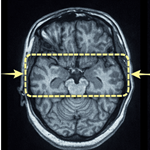
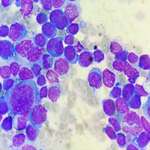
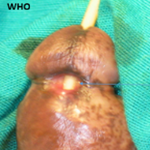
A 49-year-old female patient presented with the complaint of swelling over the left lower jaw that initially occurred 30 years ago. She had an infra-articular mass in her left parotid and was advised to undergo surgery. An arteriovenous malformation is a rare high-flow vascular abnormality characterised by direct connections between arteries and veins that lack an intervening capillary bed. The condition is gradually progressive, with pulsatile masses, and poses severe diagnostic difficulties due to its complex vascular structure. Clinically, swelling in the area was soft, pulsatile, and partially compressible. MRI Scan revealed that there is a large altered signal intensity lesion showing a tangle of serpiginous vessels on post contrast study noted in the intramuscular plane in the left parotid region of approximate size 5.2 x 9.2 x 7.4 cm seen extending superiorly up to the external auditory channel, inferiorly in upper neck region and laterally causing outward bulge on skin, medially reaching upto Buccal mucosa. The lesion has arterial feeders from branches of the left external carotid artery and early venous drainage into tributaries of the left EJV; a few vessels also drain into IJV. The Left subclavian vein is dilated and tortuous. Management and Therapeutic intervention include surgical removal of part; further short-term management will be planned based on the patient´s condition and standard surgical protocol. The receptor profile will guide medium-term management, including the surgical site dressing. Long-term management will be routine follow-ups.
Figure 1: A) vascular lesion in the left parotid region, extending to retroauricular area; B) lesion size was 5.2 X 9.2 X 7.4 cm and comprised of a mass of serpiginous vessels with significant post-contrast enhancement; C) arterial feeders developed off the left external carotid artery having an early venous drain into external and internal jugular veins
Search
This article authors
On Pubmed
On Google Scholar
Citation [Download]
Navigate this article
Similar articles in
Key words

Article metrics
Recently from the PAMJ-CM