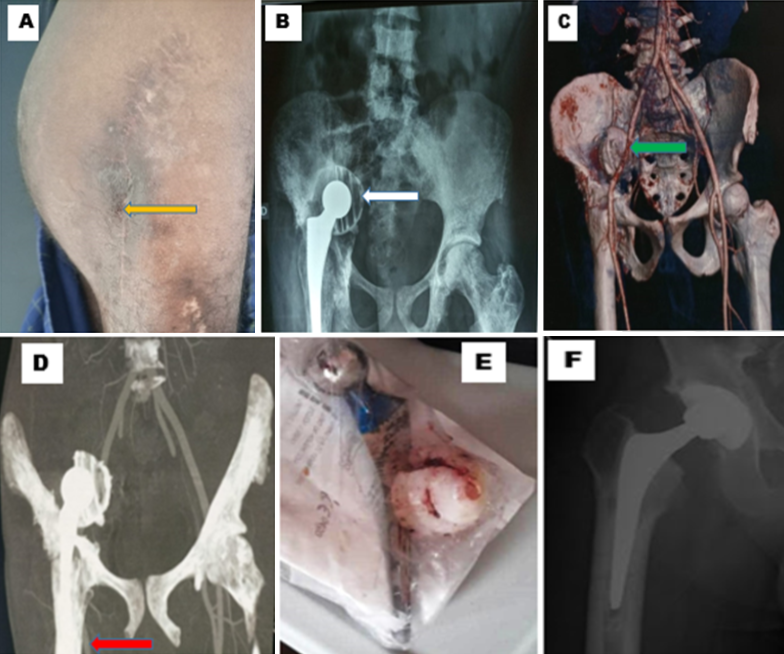
Intra-pelvic migrations of infected total hip implants are extremely rare and challenging complications. We present the case of a 30-year-old man who was referred from a sub-Saharan African country with these complications. This is a known sickle cell patient with a history of hip arthrosis due to multiple episodes of vaso-occlusive crises. He was operated on the right total hip arthroplasty 18 months before his referral. He reported a progressive unset of the pain of his right hip associated with a progressive shortening of his right lower limb and a discharge of pus from the operation site, in an apyretic context that started eight months after the surgery. He could walk with two crutches. Physical examination revealed a fistula with purulent discharge on the operation site, and a shortened right lower limb (3.5cm difference) with normal distal neurovascular examination. Waist X-ray and computed tomography showed intra-pelvic dislocation of the hip implant with deviation of right iliac arteries. A computed tomography angiogram revealed permeable right iliac arteries. C-reactive protein (CRP) was at 137mg/L with normal white blood cell count. Before implant removal, debridement, collecting samples for cultures, thorough lavage, and spacer placement, a two-week distal femoral gradual pin traction was done. <i>Staphylococcus aureus</i> sensitive to Imipenem and Amikacin was isolated, and the patient received bi-anti biotherapy for infection control as per the protocol, after which a new cemented prosthesis was reimplanted. At the last follow-up (two years), the patient had equal lower limb lengths, walked with one crutch, and had no sign of infection at the operation site.
Corresponding Author
Moustapha Etape, Department of Orthopedic Surgery and Traumatology I, Mohammed V Military Teaching Hospital, Rabat, Morocco (moustaphaetape@gmail.com)